How Sound and Technology Impact Your Natural Sleep Architecture
You have likely wondered if the gentle hum of your wifi router or the presence of a smartphone on your nightstand is the reason you are tossing and turning. Creating the perfect sleep environment involves more than just a comfortable mattress; it requires managing the invisible and audible signals that interact with your brain while you rest. When you keep a phone beside your head, you are not just contending with potential electromagnetic fields, but also the psychological alertness triggered by the possibility of incoming notifications. This constant state of low-level vigilance can alter your cortisol rhythms and delay the release of melatonin, the hormone responsible for telling your body it is time to wind down. In this article, we explore the concrete biological mechanisms that link environmental noise and technology use to fragmented sleep cycles. By understanding how external stimuli interfere with your internal chemistry, you can take control of your bedroom environment. We look at the latest research into sound sensitivity and non-ionising radiation to help you decide if a tech-free sanctuary is the missing piece in your recovery puzzle. Learn how to silence the digital noise and foster a space where your nervous system can truly disengage.
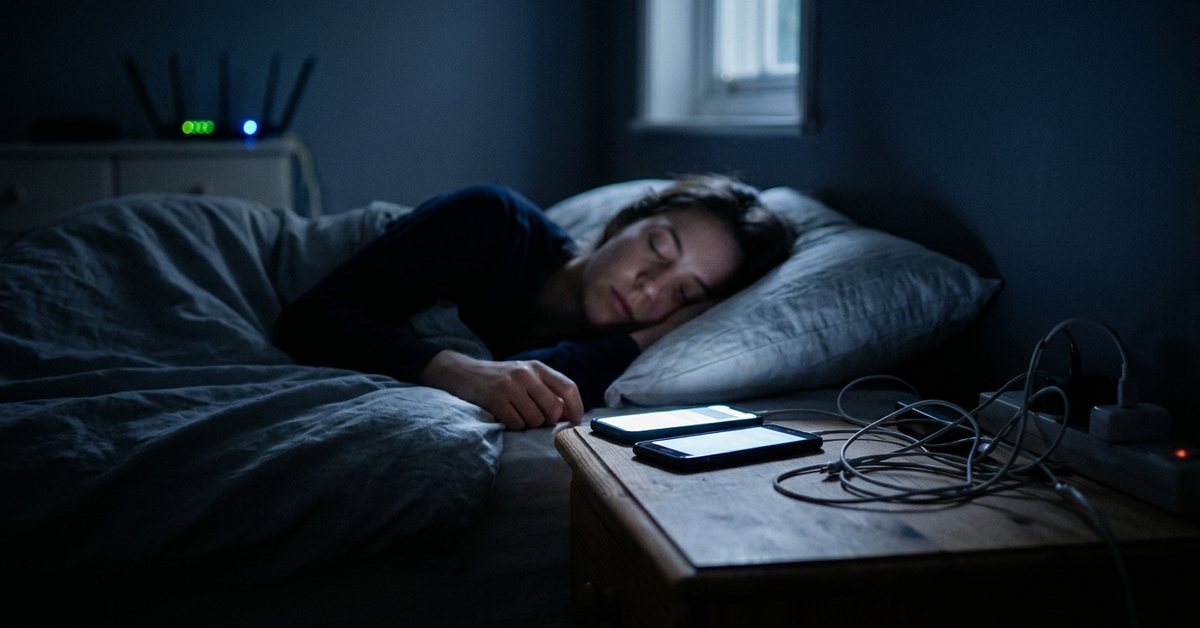
The disruption of the auditory environment
Even when you are sound asleep, your brain continues to process sounds in your environment. This is an evolutionary survival mechanism designed to alert you to potential danger while you are vulnerable. However, in the modern world, this means that intermittent noises such as a passing car, a humming refrigerator, or a buzzing phone can trigger a brief spike in brain activity without fully waking you up. These events, known as micro-arousals, can shift you from a deep, restorative sleep stage into a lighter one, leaving you feeling unrefreshed the next morning.
Research suggests that the consistency of sound is often more important than the absolute volume. While a steady white noise might help some people by masking disruptive sounds, sudden peaks in decibel levels are particularly damaging to sleep architecture. These peaks can trigger the sympathetic nervous system, leading to a slight increase in heart rate and blood pressure, even if you have no memory of the sound when you wake up in the morning.
Biological mechanisms and sleep chemistry
The primary biological mechanism affected by bedroom technology is the production of melatonin. When your eyes are exposed to the blue light emitted by phone screens, it signals the suprachiasmatic nucleus in the brain to suppress melatonin production. This delay shifts your circadian rhythm, making it harder to fall asleep at your desired time. Furthermore, the psychological anticipation of a message or notification can keep your cortisol levels elevated. Instead of the natural evening drop in cortisol that facilitates rest, your body remains in a state of high alert.
This hormonal imbalance also impacts your core body temperature and glucose metabolism. A restful night requires a slight drop in core temperature, but elevated stress hormones like cortisol can keep the body running hot. Furthermore, fragmented sleep caused by noise or light signals can interfere with the clearance of adenosine, a chemical that builds up in your brain throughout the day to create sleep pressure. If your sleep architecture is constantly interrupted, you may wake up with a high level of residual adenosine, leading to the sensation of brain fog.
The debate over wifi and EMF signals
Radiofrequency electromagnetic fields, or EMFs, are emitted by wifi routers, mobile phones, and other wireless devices. While these are classified as non-ionising radiation, meaning they lack the energy to damage DNA directly, there is ongoing scientific discussion regarding their non-thermal effects on human physiology. Some individuals report a sensitivity to these fields, claiming they experience headaches or insomnia when near active transmitters. Scientists are investigating whether these fields might influence the movement of calcium ions across cell membranes, which could theoretically impact neurotransmitter release.
Current consensus in the public health community suggests that while low-level EMF exposure from home devices is within safety guidelines, the proximity of the device matters significantly. The strength of an EMF signal drops off rapidly as you move away from the source. Therefore, keeping a phone directly beside your head represents a much higher level of exposure than a router located in another room. For those struggling with persistent insomnia, reducing all potential stressors, including invisible ones, is a common experimental step.
What the scientific research shows
Studies into the impact of mobile phones on sleep have yielded interesting results regarding brain wave patterns. Some research has indicated that exposure to mobile phone radiation before bed can increase the power of the beta frequency band in the non-REM sleep EEG, which is usually associated with wakefulness and alertness. This suggests that even if you fall asleep, the quality of that sleep may be subtly altered by the presence of a nearby active device.
In the realm of environmental noise, the evidence is even more robust. Long-term studies on residents living near airports or busy roads show a clear correlation between nocturnal noise and increased stress hormone markers. The brain does not simply habituate to noise; while you might stop waking up fully, your physiological stress response remains active. This chronic activation can lead to long-term health implications beyond simple tiredness, affecting cardiovascular health and metabolic regulation.
The psychological impact of the bedside phone
Beyond the physiological and electromagnetic concerns, the presence of a phone beside your head creates a psychological tether to the waking world. This phenomenon is often referred to as 'technostress'. The phone is a portal to work, social obligations, and global news, all of which are designed to grab and hold your attention. Having this device within arm's length makes it incredibly difficult for the brain to transition into the 'passive' state required for the onset of sleep.
Furthermore, the habit of checking the phone if you wake up during the night is a significant barrier to returning to sleep. The hit of dopamine from a new notification or the blue light from the screen acts as a powerful wake-up signal. This reinforces a cycle of fragmented sleep, where the phone becomes both the cause of the disruption and the temporary distraction from the frustration of being awake. Breaking this cycle usually requires a physical separation between the user and the technology.
Practical steps for a tech-free sanctuary
The most effective way to address these issues is to move the phone out of the bedroom entirely. Using a traditional analogue alarm clock removes the need for a digital device by your bed. If you must keep your phone in the room for emergencies, place it at least two metres away from your head and switch it to flight mode. This significantly reduces both the EMF output and the temptation to check it during the night. Turning off the wifi router at the wall before bed can also eliminate a source of ambient signal and save energy simultaneously.
To manage noise, consider using soft earplugs or a dedicated white noise machine that produces a consistent, non-looping sound. This can help mask external peaks in noise from neighbours or traffic. Ensure that your bedroom windows are well-sealed, as even small gaps can allow significant sound leakage. By creating a predictable and quiet sensory environment, you allow your brain to descend into the deeper stages of sleep without being pulled back to the surface by environmental triggers.
Conclusion and medical advice
Your bedroom should be a sanctuary dedicated to rest and recovery. By limiting the impact of noise, light, and electronic signals, you are giving your body the best possible chance to follow its natural circadian rhythms. While modern life often demands constant connectivity, the hours you spend asleep are the only time your brain has to perform essential maintenance. Small changes to your environment, such as moving your phone or silencing your router, can lead to significant improvements in how you feel each morning.
It is important to remember that while environmental factors play a large role in sleep quality, they are not the only piece of the puzzle. If you have implemented these changes and continue to experience persistent insomnia, it may be due to an underlying medical condition or a sleep disorder that requires professional attention. You should see a clinician for persistent insomnia to rule out conditions like sleep apnoea or clinical anxiety that may require specific treatment beyond environmental adjustments.
What to try tonight
- 01Move your smartphone to a different room or at least two metres away from your bed.
- 02Switch your phone to flight mode and turn off your wifi router before sleeping.
- 03Use a traditional analogue alarm clock instead of your phone to wake up.
- 04Invest in high-quality earplugs or a white noise machine to mask intermittent sounds.
- 05Establish a tech-free window 60 minutes before you intend to be asleep.
Research and references
- 1. Lusternberger et al. (2013). Inter-individual and intra-individual variation of the effects of pulsed RF EMF exposure on the sleep EEG. Bioelectromagnetics.
- 2. Basner et al. (2014). Auditory and non-auditory effects of noise on health. The Lancet.
- 3. Cajochen et al. (2011). Evening exposure to a light-emitting diodes (LED)-backlit computer screen affects circadian physiology and cognitive performance. Journal of Applied Physiology.
- 4. Hutter et al. (2010). Subjective symptoms, sleeping problems, and cognitive performance in subjects living near mobile phone base stations. Occupational and Environmental Medicine.
This page is general information, not medical advice. If sleeplessness persists for more than a few weeks, please speak with a doctor or a sleep clinician.